Production-ready packaging design for food requires locking non-printing structural dieline layers, FDA 21 CFR Part 101 panel geometry, and substrate ink limits before placing brand artwork. When a press file omits Overprint Stroke on a cut line, sets process white instead of a choked White_Ink spot plate on flexible film, or drops net weight type below the mandatory 21 CFR 101.105 height tier, the production run fails prepress inspection, wastes printed roll stock, or triggers retail compliance rejection.
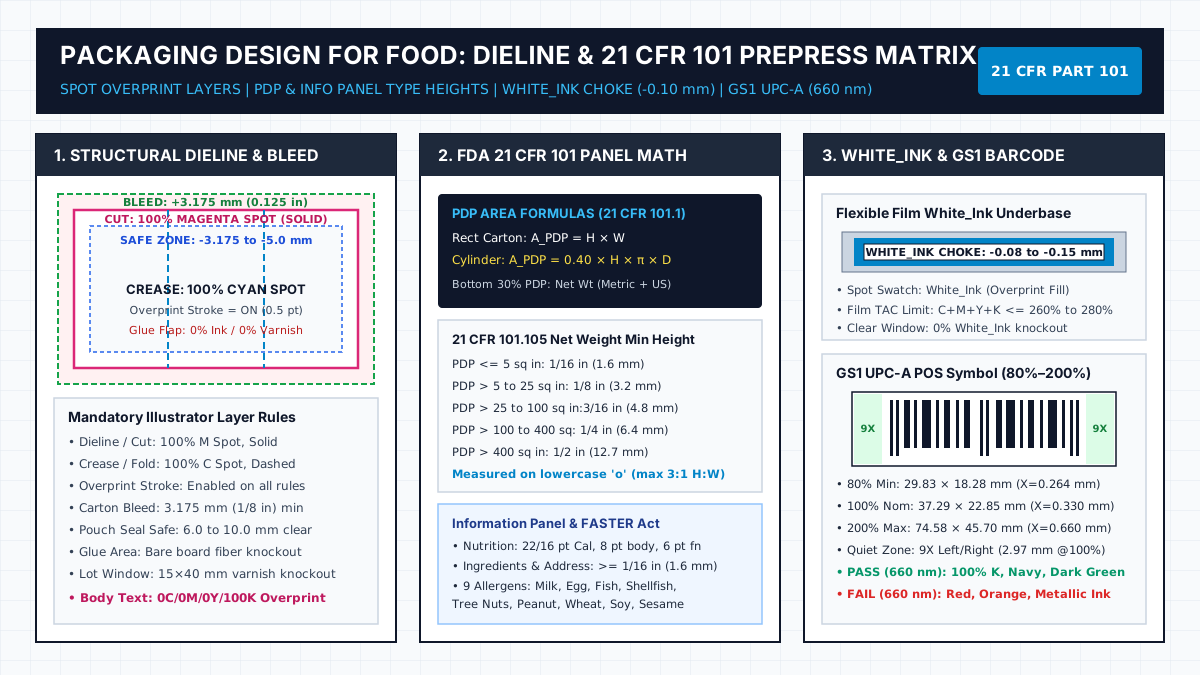
To build a press-ready food carton, pouch, or wraparound label, separate the native vector file into locked non-printing spot layers (Dieline/Cut in solid 100% Magenta Overprint Stroke, Crease/Fold in dashed 100% Cyan Overprint Stroke, and a -0.08 to -0.15 mm choked White_Ink underbase on film), size the Principal Display Panel (A_PDP = H × W for boxes or 0.40 × H × π × D for cylinders) to set the legal Net Quantity type height (1/16 in to 1/2 in based on lowercase 'o'), group the Nutrition Facts (16 pt / 8 pt / 6 pt), descending Ingredients, 9 Major Allergens, and packer address on the contiguous right Information Panel without intervening promotional copy, and place a 100% K GS1 UPC-A barcode (80% to 200% magnification with 9X quiet zones) over an opaque white patch.
| Layer / Panel Element | Spot Swatch & Overprint Mode | Dimensional Tolerance / Minimum Type Height | Governing Press or Federal Standard | Prepress or Retail Failure Consequence |
|---|---|---|---|---|
Structural Cut Line (Dieline) |
Spot Color Dieline (0C/100M/0Y/0K), solid 0.5–1.0 pt, Overprint Stroke = ON |
Bleed +3.175 mm (0.125 in) outside; live art -3.175 mm inside cut |
Converter CAD / Adobe PDF/X-4 | Unprinted white hairline gap at trim edge if stroke knocks out CMYK |
Crease / Score / Gusset (Fold) |
Spot Color Crease (100C/0M/0Y/0K), dashed 0.5–1.0 pt, Overprint Stroke = ON |
-3.175 to -5.0 mm safety clearance on both sides of score |
Folding carton die / Pouch gusset spec | Score compression crushes or clips mandatory 21 CFR 101 text along hinge |
| Glue Flap & Heat-Seal Zone | Non-printing guide (Overprint); 0% ink and 0% UV/aqueous varnish on live layers |
Full glue flap knockout on cartons; 6.0–10.0 mm seal margin on pouches |
Cold PVA / Hot-melt / Thermal jaw spec | Adhesive fails to penetrate coated fibers; cartons pop open or pouch seals leak |
| Lot / Date Coding Window | Lot_Code_Zone guide; 0% varnish knockout over white substrate or White_Ink |
Typically 15 × 40 mm clear rectangle outside fold scores and seams |
FSMA 204 / cGMP lot traceability | Thermal transfer (TTO) or continuous inkjet (CIJ) date code smears off UV varnish |
Flexible Film White_Ink Plate |
Spot Color White_Ink (100% tint), Overprint Fill = ON on dedicated plate |
-0.08 to -0.15 mm (-0.25 to -0.45 pt) choke inside CMYK/Spot edges |
Flexo / Gravure / Digital film prepress | Process white (0C/0M/0Y/0K) prints nothing; unchoked white exposes halo on film |
| Principal Display Panel (PDP) | Live artwork layer; Statement of Identity + Net Quantity in bottom 30% of panel |
Net Wt lowercase 'o': 1/16 in (<=5 sq in) up to 1/2 in (>400 sq in) |
FDA 21 CFR 101.1, 101.3, 101.105 |
Detention or re-labeling order for undersized net weight or missing metric/US dual unit |
| Information Panel (Right of PDP) | 0C/0M/0Y/100K (100% K) set to Overprint Fill for 6–8 pt regulatory text |
Ingredients, 9 Allergens, Address >= 1/16 in (1.6 mm 'o'); Nutrition 6–22 pt |
FDA 21 CFR 101.2, 101.4, 101.5, 101.9; FASTER Act |
Rich black (4C) blurs 1/16 in type on press; intervening marketing copy violates 101.2(e) |
| GS1 UPC-A Retail POS Barcode | 100% K or dark 660 nm-absorbing bars on opaque white base (0% varnish glare) |
80% (29.83 × 18.28 mm) to 200% (74.58 × 45.70 mm); 100% = 37.29 × 22.85 mm; 9X quiet zone |
GS1 General Specifications (X = 0.330 mm nominal) |
Red/orange/metallic bars reflect 660 nm laser light; violated 9X quiet zone causes POS no-read |
For a broader overview of how U.S. labeling rules differ across cosmetics, alcoholic beverages, hazardous workplace chemicals, and consumer goods, start with our pillar product label design guide or browse all production tutorials in Labels and Packaging.
Structural Dieline Architecture: Folding Cartons vs. Flexible Stand-Up Pouches
Every press-ready food package starts with the converter’s CAD dieline (supplied as a native .ai, .pdf, or .cf2 CAD file) before a single brand graphic is placed. Structural packaging falls into two primary mechanical families: die-cut paperboard folding cartons (printed on sheetfed offset or web flexo presses, creased with steel rules, and glued along a side seam) and flexible film structures such as stand-up pouches (SUP), pillow bags, and roll-fed film (printed via central-impression flexography, rotogravure, or digital web presses and thermally welded by heat-seal jaws).
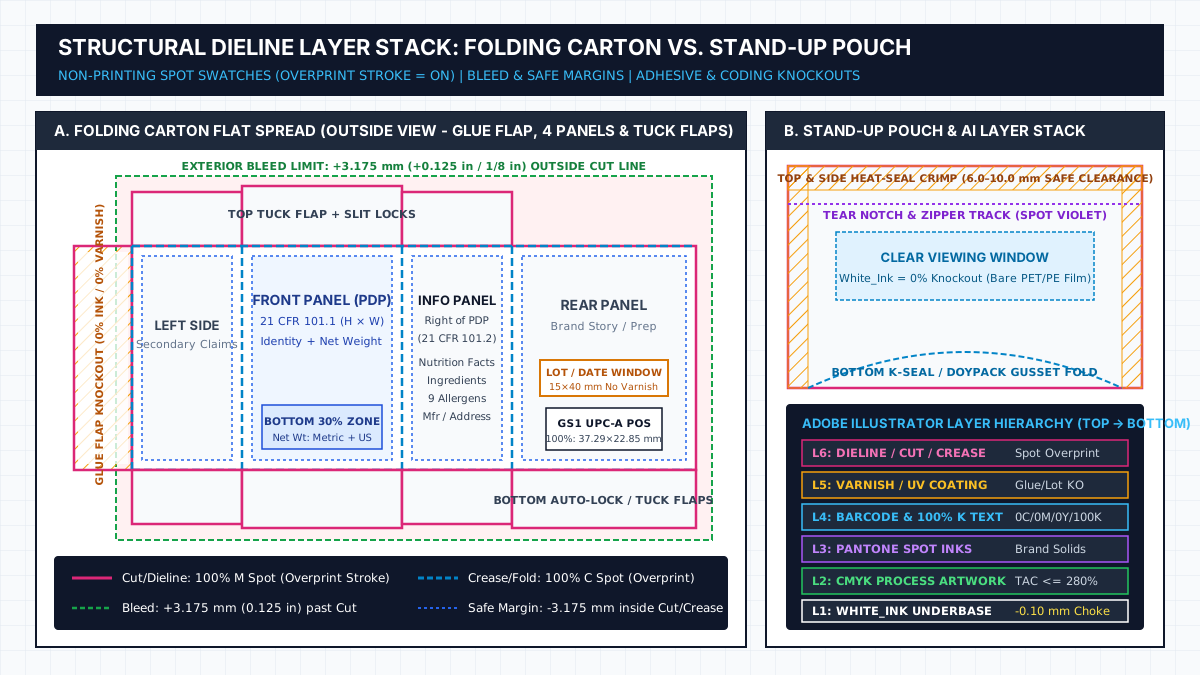
1. Non-Printing Spot Color Swatches & Overprint Stroke Mechanics
In Adobe Illustrator or InDesign, structural CAD paths must sit on their own locked top layer (Dieline or CAD_Guides) and must be colored with Spot Color swatches rather than CMYK process builds:
DielineorCutSwatch (Solid0.5 ptto1.0 ptStroke): Define as a Spot Color with a0C / 100M / 0Y / 0Kpreview and check Overprint Stroke in the Attributes panel (Window -> Attributes). This continuous path marks where steel rule die blades cut the folding carton board or where rotary knives and lasers slit flexible pouch webs.CreaseorFoldSwatch (Dashed0.5 ptto1.0 ptStroke): Define as a Spot Color with a100C / 0M / 0Y / 0K(or100% Green) preview and check Overprint Stroke. On folding cartons, this dashed path marks where rounded steel creasing rules indent the paperboard into a female matrix channel; on stand-up pouches, it marks the bottom K-seal or Doypack gusset fold lines.Perf/Tear_Notch/ZipperSwatch (Dotted Spot Violet or Yellow Stroke): Marks laser-scored easy-open tear strips, V-notches, press-to-close zipper tracks, and one-way degassing valve locations on flexible pouches. When laying out seasonal coffee bags with ultrasonic degassing valves, keep high-coverage ink and mandatory text out of the valve crush ring as detailed in our analysis of digital-printed coffee valve pouches.
Why is Overprint Stroke = ON mandatory on every structural dieline path? By default, vector strokes in Illustrator knock out underlying fills. If a 1.0 pt Magenta cut line is drawn in process CMYK or left as a knockout spot color across a dark blue carton background, the raster image processor (RIP) punches a 1.0 pt (0.35 mm) white gap directly along the trim perimeter and every fold crease when the prepress operator turns off the dieline plate. Enabling Overprint Stroke ensures continuous ink coverage underneath every cut and crease rule. Keep all dieline paths, brand marks, and micro-typography in crisp vector geometry using our vector logo and print file checklist.
2. Exterior Bleed, Interior Safety Margins & Seal-Zone Knockouts
Mechanical die-cutting platens and rotary web slitters exhibit a sheet-to-sheet or web-to-web registration tolerance of ±0.8 mm to ±1.5 mm (±1/32 in to ±1/16 in). Apply these four dimensional clearance rules across the dieline:
- Folding Carton Bleed (
+3.175 mm/0.125 inMinimum): Extend all background fills, food photography, and color blocks at least3.175 mm(1/8 in) past all exteriorCutlines and into die-cut viewing windows. Heavy litho-laminated E-flute or B-flute corrugated food boxes require5.0 mm to 6.35 mm(0.25 in) exterior bleed. - Interior Safety Margin (
-3.175 mmto-5.0 mmInside Cut & Crease): Keep all mandatory FDA 21 CFR Part 101 text, nutrition borders, and GS1 barcodes at least3.175 mm(0.125 in) inside everyCutandCreaseline on folding cartons. When heavy paperboard (250–350 gsm/12–18 ptcaliper) is creased and folded90°, the inner board ply compresses along the score bead; calculate panel width take-up and creasing channel geometry using the formulas in our brochure fold and paper weight GSM engineering guide. - Flexible Pouch Heat-Seal Safety Clearance (
6.0 mmto10.0 mm): On stand-up pouches and pillow bags, heated crimp jaws weld the inner polyethylene (PE) or cast polypropylene (CPP) sealant layer along a5.0 mm to 8.0 mmperimeter band at the left/right side seals, top header seal, and bottom gusset. Keep all mandatory regulatory text, allergen statements, and barcodes6.0 mm to 10.0 mmclear of heat-seal zones, hang holes, and zipper tracks so jaw serrations never distort1/16 intype. - Glue Flap & Date/Lot Coding Knockouts (
0%Ink /0%Varnish):- Carton Side Glue Flap: Cold polyvinyl acetate (PVA) emulsion and hot-melt packaging adhesives bond by penetrating raw paperboard cellulose fibers. If flood CMYK ink, UV coating, aqueous varnish, or film lamination covers the glue flap, the adhesive sits on a sealed polymer skin and pops open on high-speed cartoning lines. Knock out (
0%) all ink and coating layers across the glue area (or apply a converter-specified checkerboard glue assist pattern). - FSMA 204 / cGMP Lot & Date Window: Reserve a
15 × 40 mmunvarnished white rectangle on the rear, side, or bottom panel so continuous inkjet (CIJ) or thermal transfer overprinting (TTO) date coders bond directly to porous ink/board without smearing. For UV-laser ablation coding, print a dedicated dark ink patch over an opaque white base with0%overprint varnish.
- Carton Side Glue Flap: Cold polyvinyl acetate (PVA) emulsion and hot-melt packaging adhesives bond by penetrating raw paperboard cellulose fibers. If flood CMYK ink, UV coating, aqueous varnish, or film lamination covers the glue flap, the adhesive sits on a sealed polymer skin and pops open on high-speed cartoning lines. Knock out (
Takeaway: Lock all structural Cut (100% M solid) and Crease (100% C dashed) paths on a top non-printing Spot Color layer with Overprint Stroke = ON, extend bleed 3.175 mm (0.125 in) past cut lines, hold live regulatory copy 3.175–5.0 mm inside folds (6.0–10.0 mm clear of pouch heat seals), and knock out 100% of ink and varnish on glue flaps and lot-code windows.
FDA 21 CFR Part 101 Panel Geometry & Mandatory Typography Math
In U.S. retail food packaging, panel assignment and minimum type sizes are governed by mathematical formulas in Title 21 of the Code of Federal Regulations, Part 101 (21 CFR Part 101) and the Federal Food, Drug, and Cosmetic Act (21 U.S.C. 343). A layout that treats regulatory text as flexible body copy risks customs detention, FDA warning letters, or retailer delisting.
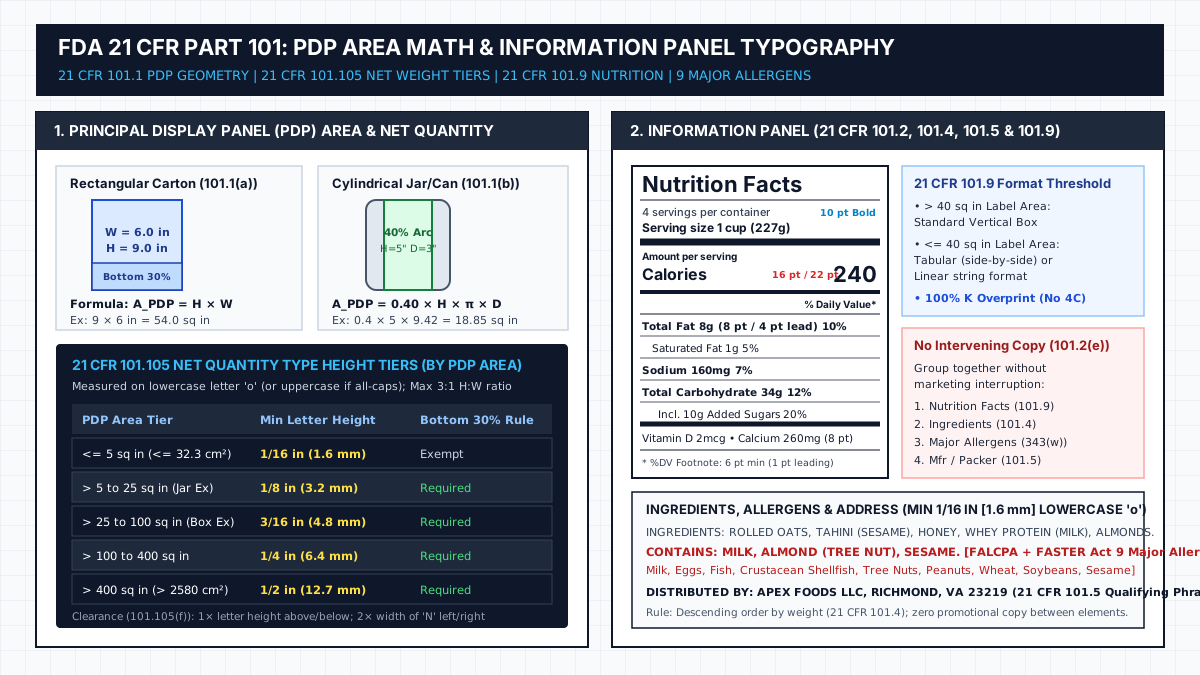
1. Calculating Principal Display Panel (PDP) Area (21 CFR 101.1)
The Principal Display Panel (PDP) is the surface of a food package most likely to be displayed, presented, shown, or examined under customary conditions of retail sale (21 CFR 101.1). Before setting a single font size on the front panel, calculate the legal PDP area (A_PDP) from the container’s physical dimensions (excluding tops, bottoms, can flanges at tops and bottoms, and bottle necks or jar shoulders):
- Rectangular Package (Folding Carton, Box, or Flat Pouch -
21 CFR 101.1(a)):APDP = H × WWhereHis the height andWis the width of the entire front panel. - Cylindrical or Nearly Cylindrical Package (Cans, Jars, Tubs, Round Bottles -
21 CFR 101.1(b)):APDP = 0.40 × H × Circumference = 0.40 × H × π × DWhereHis the usable body height (excluding shoulder, neck, and bottom heel) andDis the outer cylinder diameter. On a wraparound label, all mandatory PDP elements must appear together within the40%arc of the circumference most likely to face the shopper on the shelf. - Other Shapes & Stand-Up Pouches (
21 CFR 101.1(c)):APDP = 0.40 × Atotal_surfaceHowever, if the package presents an obvious principal display surface (such as the flat circular lid of a hummus tub or the front face of a gusseted stand-up pouch),A_PDPequals the area of that entire obvious front surface.
2. Mandatory PDP Elements & Net Quantity Type Height Tiers (21 CFR 101.3 & 101.105)
Two regulatory elements must appear on the PDP parallel to the base on which the package rests:
- Statement of Identity (
21 CFR 101.3): The common or usual name of the food (or an established standard of identity name, or a fanciful brand descriptor accompanied by the mandatory descriptive term) set in bold type in a size reasonably related to the most prominent printed matter on the PDP (generally at least50%of the height of the largest type on the panel). - Net Quantity of Contents (
21 CFR 101.105): Expressed in both metric units (gramsg, kilogramskg, millilitersmL, or litersL) and U.S. customary avoirdupois weight or fluid measure (ouncesoz, poundslb, fluid ouncesfl oz, pints, quarts, or gallons), e.g.,NET WT 12 OZ (340 g)or16 FL OZ (1 PT) 473 mL.
Under 21 CFR 101.105(f)-(i), the Net Quantity declaration must obey four strict geometric rules:
- Measurement Standard (
21 CFR 101.105(h)(1)): Minimum type height applies to uppercase letters when printed in all-capitals (NET WT 12 OZ (340 G)), or to the lowercase letter'o'(x-height) when upper- and lowercase letters are used (Net Wt 12 oz (340 g)). Letters must never exceed a3:1height-to-width aspect ratio (no ultra-condensed typefaces). - Bottom 30% Placement Rule (
21 CFR 101.105(f)): For any package withA_PDP > 5 sq in, the Net Quantity statement must sit entirely within the bottom 30% of the PDP. - Clearance Isolation Zone (
21 CFR 101.105(f)): The Net Quantity line must be separated from all other printed label copy above and below by a minimum vertical space equal to1×the height of the lettering (H_clear_vert >= H_letter), and to the left and right by a minimum horizontal space equal to2×the width of the letter'N'of the typeface used (W_clear_horiz >= 2 × W_N).
Calculated A_PDP Area Range |
Minimum Letter Height (in) |
Minimum Letter Height (mm) |
Minimum x-Height in Typographic Points (1 in = 72 pt) |
Approximate Body Font Size if Mixed-Case (x-height ≈ 0.50 em) |
Bottom 30% PDP Placement Required? |
|---|---|---|---|---|---|
<= 5 sq in (<= 32.3 cm²) |
1/16 in (0.0625 in) |
1.59 mm (1.6 mm) |
4.5 pt minimum height |
~9 to 10 pt (or 5 pt if All-Caps) |
Exempt (21 CFR 101.105(f)) |
> 5 to <= 25 sq in (32.3–161.3 cm²) |
1/8 in (0.1250 in) |
3.18 mm (3.2 mm) |
9.0 pt minimum height |
~18 to 20 pt (or 10 pt if All-Caps) |
Mandatory (Bottom 30% of PDP) |
> 25 to <= 100 sq in (161.3–645.2 cm²) |
3/16 in (0.1875 in) |
4.76 mm (4.8 mm) |
13.5 pt minimum height |
~27 to 30 pt (or 14 pt if All-Caps) |
Mandatory (Bottom 30% of PDP) |
> 100 to <= 400 sq in (645.2–2580.6 cm²) |
1/4 in (0.2500 in) |
6.35 mm (6.4 mm) |
18.0 pt minimum height |
~36 to 40 pt (or 19 pt if All-Caps) |
Mandatory (Bottom 30% of PDP) |
> 400 sq in (> 2580.6 cm²) |
1/2 in (0.5000 in) |
12.70 mm (12.7 mm) |
36.0 pt minimum height |
~72 to 80 pt (or 37 pt if All-Caps) |
Mandatory (Bottom 30% of PDP) |
Worked Example 1: Sizing PDP Area & Net Weight Type for a Cylindrical Glass Jar vs. a Folding Carton
Suppose you are building prepress templates for two products in the same food brand line: (A) a cylindrical glass pasta sauce jar with usable label body height H = 5.0 in (127.0 mm, below the neck shoulder) and outer diameter D = 3.0 in (76.2 mm), and (B) a rectangular cracker folding carton measuring W = 6.0 in (152.4 mm) wide by H = 9.0 in (228.6 mm) high:
- Case A - Cylindrical Glass Sauce Jar (
H = 5.0 in,D = 3.0 in):- Container Circumference:
C = π × D = 3.1416 × 3.0 in = 9.4248 in(239.4 mm). - Legal PDP Area (
21 CFR 101.1(b)):APDP = 0.40 × 5.0 in × 9.4248 in = 18.85 sq in (121.6 cm²) - Maximum Shelf-Facing PDP Arc Width:
W_PDP_arc = 0.40 × 9.4248 in = 3.77 in(95.8 mm). Both the Statement of Identity and Net Quantity must sit within this3.77 inhorizontal window on the wraparound label. - Net Quantity Height Tier (
> 5 to <= 25 sq in): Since18.85 sq infalls in the5 to 25 sq intier, the minimum letter height is1/8 in(0.125 in/3.18 mm/9.0 ptphysical glyph height). If printed in mixed case (Net Wt 24 oz (1 lb 8 oz) 680 g), the lowercase'o'must measure at least3.18 mmtall with a caliper ruler (~18 ptHelvetica/Franklin Gothic body size). - Bottom 30% Zone Height:
H_bottom_30 = 0.30 × 5.0 in = 1.50 in(38.1 mm) measured upward from the bottom label trim edge, with at least3.18 mm(1/8 in) vertical clearance above and below the text line.
- Container Circumference:
- Case B - Rectangular Cracker Folding Carton (
W = 6.0 in,H = 9.0 in):- Legal PDP Area (
21 CFR 101.1(a)):APDP = 9.0 in × 6.0 in = 54.0 sq in (348.4 cm²) - Net Quantity Height Tier (
> 25 to <= 100 sq in): Since54.0 sq inexceeds the25 sq inthreshold, the minimum letter height steps up to3/16 in(0.1875 in/4.76 mm/13.5 ptphysical glyph height) inside the bottom0.30 × 9.0 in = 2.70 in(68.6 mm) zone of the front carton panel.
- Legal PDP Area (
3. Information Panel Grouping, Nutrition Facts (21 CFR 101.9) & the 9 Major Allergens
Under 21 CFR 101.2(a), the Information Panel is the panel immediately contiguous and to the right of the PDP as observed by a shopper facing the front of the package (if that right side gusset or flap is too narrow or creased to accommodate text, the next contiguous panel to the right, typically the rear panel, serves as the Information Panel).
Under 21 CFR 101.2(e), all mandatory Information Panel elements must be grouped together in one contiguous block without any intervening non-mandatory marketing copy, recipes, brand stories, QR codes, or promotional illustrations:
- Nutrition Facts Panel (
21 CFR 101.9):- Standard Vertical Format (
> 40 sq inTotal Surface Area Available to Bear Labeling): Enclosed in a0.5 pthairline box with>= 3 ptinternal horizontal clearance;"Nutrition Facts"header fills the full width;"Calories"label in16 pt boldand numeric calorie count in22 pt bold;"Serving size"in10 pt bold; nutrient listings, gram/milligram weights, and% Daily Valuein8 ptregular/bold sans-serif (>= 4 ptleading) separated by7 pt,3 pt, and0.5 ptbars;%DVfootnote in6 ptminimum type (>= 1 ptleading). - Small & Intermediate Package Exemptions (
<= 40 sq inAvailable Label Area -21 CFR 101.9(j)(13)): Packages with40 sq inor less of total surface area available for labeling may use the side-by-side Tabular format without special FDA permission, or the Linear (string) format if the container geometry cannot accommodate a tabular box.
- Standard Vertical Format (
- Ingredient List (
21 CFR 101.4): Listed by common or usual name in descending order of predominance by weight (>= 1/16 in/1.6 mmlowercase'o'height). Sub-ingredients of multi-component ingredients must be declared in parentheses. - Major Food Allergen Declaration (
21 U.S.C. 343(w)- FALCPA + FASTER Act): Federal law mandates explicit declaration of the 9 major food allergens: Milk, Eggs, Fish (specific finfish species such as cod or salmon), Crustacean Shellfish (specific species such as crab, lobster, or shrimp), Tree Nuts (specific nut such as almond, walnut, or pecan), Peanuts, Wheat, Soybeans, and Sesame (added as the 9th major allergen under the FASTER Act). Declare allergens either in parentheses immediately after the ingredient source (tahini (sesame), whey (milk)) or in a bold"Contains:"statement immediately adjacent to the ingredient list in the exact same minimum type size (>= 1/16 inlowercase'o'). - Name and Place of Business (
21 CFR 101.5): Street address, city, state, and ZIP code of the manufacturer, packer, or distributor (>= 1/16 inlowercase'o'; street address may be omitted only if listed in a current city or telephone directory). If the named company is not the actual manufacturer, the address must be preceded by a qualifying phrase such as"Manufactured for ___"or"Distributed by ___".
Takeaway: Compute A_PDP before choosing front-panel font sizes, measure the 1/16 in (1.6 mm) to 1/2 in (12.7 mm) height rules physically on the lowercase letter 'o' in Illustrator (not the nominal point size box), and keep Nutrition Facts, Ingredients, the 9 Major Allergens, and the distributor address grouped together on the right Information Panel with zero intervening marketing copy.
Flexible Packaging White_Ink Underbase Choke & CMYK vs. RGB Printing
Moving a food package from a designer’s backlit monitor to a central-impression (CI) flexographic, rotogravure, or offset press exposes two high-cost prepress failure modes: transparent inks over unbacked film and gamut/registration shifts during cmyk vs rgb printing.
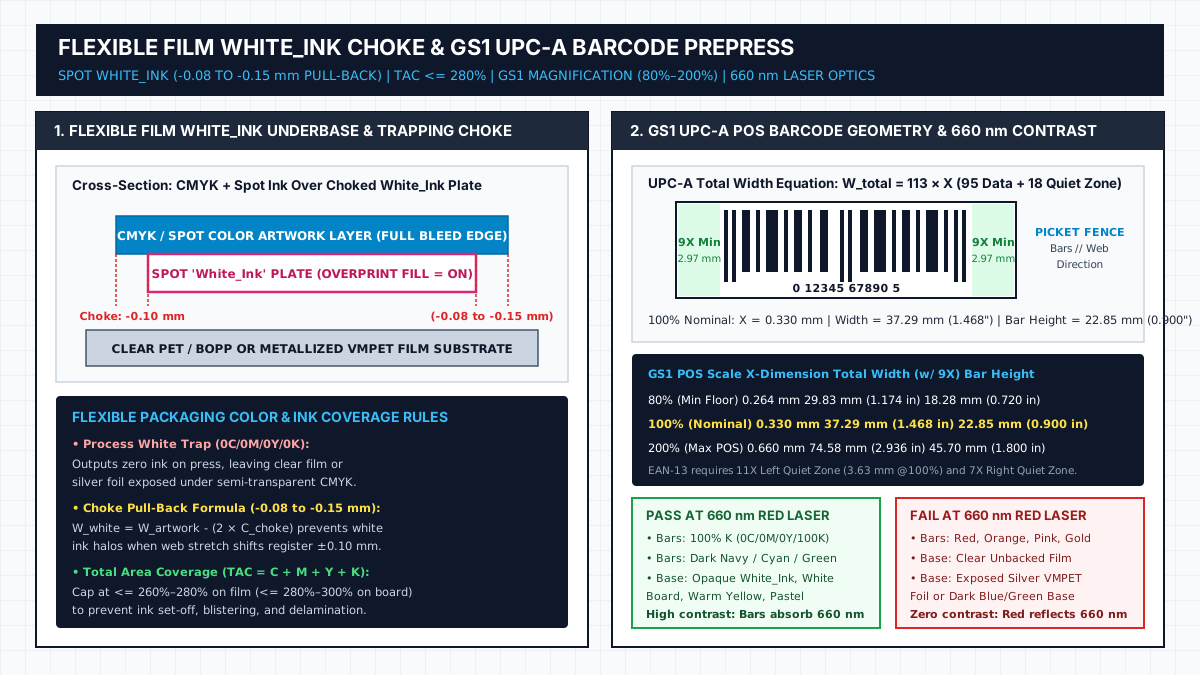
1. Why Process White (0C/0M/0Y/0K) Disappears on Clear & Metallized Film
On white clay-coated paperboard cartons (such as SBS or CUK board), the substrate itself provides reflectance, so a 0C / 0M / 0Y / 0K swatch reveals the white paperboard underneath. On flexible snack pouches, frozen food bags, and shrink sleeves printed on clear films (oriented polypropylene BOPP, polyester PET, or polyethylene PE) or metallized laminates (vacuum-metallized VMPET or aluminum foil), process CMYK inks are translucent filters. Printing CMYK food photography or white nutrition text using 0C/0M/0Y/0K applies zero ink, leaving clear plastic or mirror-like silver foil exposed.
To print opaque graphics and scannable white reverses on film, configure a dedicated Spot White separation plate in Adobe Illustrator:
- Create a new swatch named exactly per the converter’s specification (
White_Ink,Spot_White, orWhite_Underbase), set Color Type = Spot Color, and assign a visible preview tint (such as30% Cyanor50% Magenta) so you can inspect coverage on screen. - Place all white-backed regions on a dedicated layer (
White_Ink) and enable Overprint Fill (and Overprint Stroke where applicable) in the Attributes panel. IfOverprint Fillis left unchecked, theWhite_Inkobject knocks out the overlying CMYK and Pantone ink plates, printing a blank white patch instead of your artwork! Walk through our step-by-step diagnostic on why white objects disappear or knock out in PDF overprint to verify separations in Acrobat Pro Output Preview. - Selective Window & Metallic Knockouts: Set
White_Ink = 0%inside clear product viewing windows (so shoppers can inspect the dry pasta, granola, or nuts inside the pouch) and under specific colored ink areas where a deliberate foil luster is desired on metallized film. Compare laminate foil knockouts against inline dispersion alternatives in our review of metallic packaging coatings without foil. - Apply a
-0.08 to -0.15 mmChoke (Pull-Back) to theWhite_InkPlate: On web-fed flexographic and gravure presses, thin polymer films stretch slightly under tension, causing±0.10 mmplate-to-plate register bounce. If theWhite_Inkunderbase is exactly the same width as a dark colored logo or panel edge (W_white = W_artwork), a0.10 mmweb shift exposes an unsightly white halo along one edge. Pull the perimeter of theWhite_Inkshape inward (choke) byC_choke = 0.08 to 0.15 mm(0.25 to 0.45 pt) on all sides (Object -> Path -> Offset Path -> -0.10 mm) according to:Wwhite = Wartwork − (2 × Cchoke)
2. CMYK vs. RGB Printing: ICC Profiles, TAC Limits & 100% K Micro-Type
When brand teams evaluate cmyk vs rgb printing for food packaging, the core prepress risk is late, uncontrolled color conversion. Culinary photography and vibrant flavor badges designed in sRGB or Display P3 contain high-chroma reds, neon lime greens, and royal blues outside the four-color CMYK gamut. Before converting any native file, confirm who performs the profile conversion and which output intent the PDF must carry using our CMYK vs RGB print handoff decision sheet.
Enforce these three color separation thresholds on every food label and carton file:
- Total Area Coverage (
TAC <= 260%–280%on Film;<= 280%–300%on Board): Total Area Coverage is the sum of all four process ink channels at any pixel:TAC = C + M + Y + KOn non-absorbent flexible films (PET,BOPP,PE), laying downTAC > 280%prevents solvent or water-based inks from drying fully inside the inter-station dryers, causing ink set-off on the rewind roll, trapped solvent odors, or bond delamination when adhesive laminates the printed web to the sealant layer. On coated folding cartons (converted underGRACoL 2013orISO Coated v2), capTAC <= 280%–300%. - Pantone Spot Stations vs. Process Builds: Commercial packaging presses typically run
6 to 10ink stations (CMYK+White_Ink+2 to 4 Pantone Spot stations+Varnish). Assign dedicated Pantone Spot ink stations to large solid brand fields, flavor-variant color bands, and fine colored reverses so large shelf blocks never suffer from CMYK rosette moire or hue drift across runs. 100% KOverprint for6 ptto8 ptRegulatory Copy: Never set the Nutrition Facts panel, ingredient list, allergen statement, or net weight in 4-color rich black (e.g., 60C/50M/50Y/100K) or theRegistrationswatch. A0.10 mmpress register shift on 4-color6 pttype fringes every letter with cyan and magenta halos, rendering1/16 in(1.6 mm) text illegible. Set all black regulatory copy and nutrition hairlines to0C / 0M / 0Y / 100K(100% Process Black) withOverprint Fill = ON, and reserve rich black strictly for large display fills as explained in our rich black vs registration black guide. When printing on grease-resistant barrier papers, always verify dot gain and ink rub on a physical press proof using the checks in our UPM Asendo 80 barrier paper guide.
Worked Example 2: Calculating White_Ink Choke & Film-Safe CMYK TAC
Suppose you are preparing a metallized VMPET/PE stand-up snack pouch featuring (1) a 4.00 mm wide dark green organic badge border backed by White_Ink, and (2) a deep espresso brown background converted from an RGB brand mockup that currently measures 75C / 68M / 72Y / 85K:
White_InkUnderbase Choke Calculation (C_choke = 0.12 mm):- Using the choke formula
W_white = W_artwork - (2 × C_choke):Wwhite = 4.00 mm − (2 × 0.12 mm) = 4.00 mm − 0.24 mm = 3.76 mm - In Illustrator, duplicate the
4.00 mmartwork shape onto theWhite_Inklayer, applyOffset Path = -0.12 mm(-0.34 pt), assign100% White_InkSpot color, and turn onOverprint Fill. The colored ink overhangs the white underbase by0.12 mmon both edges, absorbing up to±0.12 mmof press web bounce without flashing a white edge.
- Using the choke formula
- CMYK Total Area Coverage (
TAC) Reduction for Flexible Film:- Initial RGB-Converted Build:
TAC_initial = 75% C + 68% M + 72% Y + 85% K = 300%. This exceeds the260%–280%flexible film ceiling and risks lamination blistering. - GCR (Gray Component Replacement) Adjusted Build: Replace neutral CMY gray density with Black (
K) to set55% C + 50% M + 55% Y + 80% K:TACadjusted = 55 + 50 + 55 + 80 = 240% (<= 260% film limit) - Regulatory Text Plate Check: All
8 ptNutrition Facts rows and1/16 iningredient lines sitting inside a white panel box are set to0C / 0M / 0Y / 100K(TAC = 100%) withOverprint Fill = ONover the100% White_Inkpatch.
- Initial RGB-Converted Build:
Takeaway: Always build an explicit Spot White_Ink plate (Overprint Fill = ON, choked -0.08 to -0.15 mm) for clear or metallized packaging films, cap CMYK TAC <= 260%–280% on film (<= 300% on board), and lock all 6–8 pt regulatory text at 0C/0M/0Y/100K Overprint.
GS1 POS Barcode Prepress: Magnification, Quiet Zones & 660 nm Contrast
A food package that passes FDA 21 CFR Part 101 inspection will still incur supermarket chargebacks and manual re-stickering fees if its GS1 UPC-A (12-digit GTIN-12 for North America) or EAN-13 (13-digit GTIN-13 international) barcode fails point-of-sale (POS) checkout scanning.
1. GS1 Magnification Tiers (80% to 200%), X-Dimension & 9X Quiet Zones
Under the GS1 General Specifications, every EAN/UPC symbol is constructed from a fixed number of modules of fundamental width X (X-dimension). A complete UPC-A symbol is exactly 113 modules wide: 95 data/guard modules (3 left guard + 42 left data + 5 center guard + 42 right data + 3 right guard) plus 18 quiet zone modules (9X clear margin on the left and 9X clear margin on the right):
- UPC-A Total Symbol Width Formula (Including Quiet Zones):
WUPC-A = 113 × X = (95 × Xbars) + (9 × Xleft_QZ) + (9 × Xright_QZ) - EAN-13 Total Symbol Width Formula (
11XLeft Quiet Zone +95XBars +7XRight Quiet Zone):WEAN-13 = 113 × X = (95 × Xbars) + (11 × Xleft_QZ) + (7 × Xright_QZ)
Retail POS barcodes must be scaled proportionally within the legal 80% to 200% magnification range (100% nominal X = 0.330 mm / 0.0130 in):
| GS1 Magnification Tier | Module Width X (mm / in) |
UPC-A Total Width w/ 9X Quiet Zones (mm / in) |
UPC-A Full Bar Height (mm / in) |
UPC-A Min Left/Right Quiet Zone (9X) |
EAN-13 Min Left (11X) / Right (7X) Quiet Zone |
Primary Packaging Application |
|---|---|---|---|---|---|---|
80% (Minimum POS Floor) |
0.264 mm (0.0104 in) |
29.83 mm (1.174 in) |
18.28 mm (0.720 in) |
2.38 mm (0.094 in) each side |
2.90 mm (L) / 1.85 mm (R) |
Space-constrained spice jars, single-serve bars (<= 40 sq in) |
90% (Compact Offset/Digital) |
0.297 mm (0.0117 in) |
33.56 mm (1.321 in) |
20.57 mm (0.810 in) |
2.67 mm (0.105 in) each side |
3.27 mm (L) / 2.08 mm (R) |
Small folding cartons, high-line-screen narrow-web labels |
100% (Nominal Target) |
0.330 mm (0.0130 in) |
37.29 mm (1.468 in) |
22.85 mm (0.900 in) |
2.97 mm (0.117 in) each side |
3.63 mm (L) / 2.31 mm (R) |
Standard grocery folding cartons, jars, cans, and stand-up pouches |
120% (Wide Web Flexo) |
0.396 mm (0.0156 in) |
44.75 mm (1.762 in) |
27.42 mm (1.080 in) |
3.56 mm (0.140 in) each side |
4.36 mm (L) / 2.77 mm (R) |
Flexible frozen bags or lower-LPI corrugated food trays |
200% (Maximum POS Ceiling) |
0.660 mm (0.0260 in) |
74.58 mm (2.936 in) |
45.70 mm (1.800 in) |
5.94 mm (0.234 in) each side |
7.26 mm (L) / 4.62 mm (R) |
Bulk club-store multipacks, master retail cases, and large bags |
Worked Example 3: Sizing a UPC-A Symbol & Quiet Zones at 80% vs. 100% Magnification
Suppose a designer is fitting a UPC-A barcode onto a narrow snack bar wrapper (80% minimum scale) versus a standard cereal carton (100% nominal scale), with a flexo press requiring BWR = 0.020 mm (20 µm) of Bar Width Reduction to compensate for ink squeeze:
- At
100%Nominal Scale (X = 0.330 mm):- Left & Right
9XQuiet Zones:W_QZ = 9 × 0.330 mm = 2.97 mm(0.117 in). Neither the outside0system digit nor the right check digit may be touched by a bounding box border or dieline crease inside this2.97 mmmargin. - Total White Box Width:
W_UPC-A = 113 × 0.330 mm = 37.29 mm(1.468 in) by22.85 mm(0.900 in) bar height. - Prepress Bar Width Reduction (
BWR = 0.020 mm): A nominal1Xbar (0.330 mm) is drawn in the vector prepress file at:Wbar_file = 0.330 mm − 0.020 mm = 0.310 mmWhen the flexo photopolymer plate squeezes ink outward by+0.010 mmper edge (+0.020 mmtotal), the printed bar lands at0.330 mm(ISO/IEC 15416Grade A/B).
- Left & Right
- At
80%Minimum Legal Floor (X = 0.264 mm):- Left & Right
9XQuiet Zones:W_QZ = 9 × 0.264 mm = 2.376 mm(2.38 mm/0.094 in). - Total White Box Width:
W_UPC-A = 113 × 0.264 mm = 29.832 mm(29.83 mm/1.174 in) by18.28 mm(0.720 in) bar height. Scaling below80%(< 29.83 mmtotal width) or truncating bar height prevents bi-optic checkout scanners from reading the package at retail speed.
- Left & Right
2. 660 nm Red Laser Contrast, Picket Fence Orientation & Curvature Limits
Protect barcode scannability against these three physical press variables:
660 nmRed Light Spectral Contrast: Supermarket laser and linear CCD scanners illuminate barcodes with red light at660 nm(650–664 nm). To the scanner sensor, red, orange, pink, coral, and warm brown inks reflect660 nmred light just like white paper, making red bars completely invisible (0%reflectance contrast). Always print dark bars in100% Process Black(0C/0M/0Y/100K), dark navy blue, dark cyan, or dark forest green (which absorb red light) over an opaque white background (100% White_Inkon film, bare white paperboard, or warm yellow/pastel). Never place barcodes over clear unbacked film or bare silver metallizedVMPETfoil.- Picket Fence vs. Ladder Orientation: Orient barcode bars parallel to the press web / machine direction (“Picket Fence” orientation) whenever possible so any mechanical press slur or web stretch occurs along the vertical length of the bars rather than bleeding across the narrow
0.264–0.330 mminter-bar spaces. - Narrow Cylindrical Containers: Only rotate the barcode
90°into “Ladder” orientation (bars wrapping horizontally around the cylinder like ladder rungs) on narrow jars, cans, or bottles where the horizontal curvature angle across the symbol exceeds30°, which would otherwise foreshorten the outer guard bars from the scanner’s line of sight.
Takeaway: Size GS1 UPC-A symbols strictly between 80% (29.83 × 18.28 mm) and 200% (74.58 × 45.70 mm) with 100% (37.29 × 22.85 mm) as the default target, keep a 9X clear quiet zone on both ends, print bars in 100% K (never red, orange, or metallic ink) over an opaque white patch, and align bars in Picket Fence direction parallel to the press web.
Food Label Dieline Checklist for Prepress Handoff
Before exporting your PDF/X-4 or PDF/X-1a production file and packaging native source assets via our InDesign links and fonts handoff checklist, run this 10-point food label dieline checklist across your artwork and Acrobat Pro Output Preview:
| # | Verification Item | Target Prepress & Regulatory Specification | Pass Criteria in Illustrator / Acrobat Pro |
|---|---|---|---|
| 1 | Non-Printing CAD Layers | Dieline/Cut (100% M solid), Crease/Fold (100% C dashed), Perf/Zipper (Spot Violet) |
All CAD paths sit on locked top layer; Spot Color swatches with Overprint Stroke = ON |
| 2 | Bleed & Interior Safe Zones | Cartons: +3.175 mm (0.125 in) bleed, -3.175 mm safe zone; Pouches: 6.0–10.0 mm seal clearance |
Background fills extend to full bleed; zero mandatory 21 CFR 101 text crosses safe or seal guides |
| 3 | Glue Flap & Lot Window | Carton glue flap: 0% ink / 0% varnish; Date/Lot window (15 × 40 mm): 0% varnish over white |
Toggle Varnish/Coating and CMYK plates in Output Preview to confirm 0% coverage in knockout zones |
| 4 | Flexible Film White_Ink Plate |
Dedicated Spot White_Ink swatch (Overprint Fill = ON), choked -0.08 to -0.15 mm at edges |
Turning off White_Ink in Separations Preview reveals colored art; clear windows show 0% White_Ink |
| 5 | PDP Area & Identity (101.1 / 101.3) |
A_PDP = H × W (box) or 0.40 × H × π × D (cylinder); bold Statement of Identity parallel to base |
Common or usual food name is prominent on PDP (and within 40% circumference arc on round jars) |
| 6 | Net Quantity Height & Clearance (101.105) |
Dual metric + US units in bottom 30% of PDP; lowercase 'o' height 1/16", 1/8", 3/16", 1/4", or 1/2" |
Measure physical lowercase 'o' height with Illustrator ruler; 1× height vertical & 2× 'N' horizontal clearance |
| 7 | Information Panel Grouping (101.2(e)) |
Nutrition (101.9), Ingredients (101.4), 9 Allergens (343(w)), and Address (101.5) grouped on right panel |
Zero intervening marketing copy, slogans, recipes, or illustrations between mandatory elements |
| 8 | Micro-Typography & Allergens | Ingredients, 9 Major Allergens (incl. Sesame), and Address >= 1/16 in (1.6 mm 'o'); Nutrition 22/16/10/8/6 pt |
All 6–8 pt black text is 0C/0M/0Y/100K (Overprint Fill = ON); zero 4-color rich black on small type |
| 9 | CMYK Profile & Total Ink (TAC) |
Converter ICC profile embedded; TAC <= 260%–280% on flexible film, <= 280%–300% on paperboard |
Acrobat Output Preview -> Total Area Coverage warning set to 260% (film) or 280% (board) shows zero flags |
| 10 | GS1 UPC-A / EAN-13 Barcode | 80%–200% magnification (100% = 37.29 × 22.85 mm), 9X (2.97 mm) quiet zones, 100% K vector bars |
Vector bars (0C/0M/0Y/100K) sit over opaque white patch (0% varnish glare); Picket Fence orientation |
Takeaway: Complete all 10 separation, overprint, panel area, and barcode verification checks in Acrobat Pro Output Preview before releasing native files or PDF/X-4 press proofs to the converter.
Related Reading
- Product Label Design: Types, Required Elements, Free Tools - Compare U.S. federal labeling requirements across food, cosmetics, alcoholic beverages, and workplace chemicals.
- CMYK vs RGB for Print: A Handoff Decision Sheet - Confirm who converts RGB brand files, which ICC profile is the target, and how to inspect PDF output intents.
- White Objects Disappear When Exporting: Check a Print Logo in Illustrator and PDF - Separate
0C/0M/0Y/0Kprocess white from a named SpotWhite_Inkplate and verify Overprint Fill in Acrobat. - Brochure Design Ideas: Fold Types, Panel Width Math & Paper Weight GSM - Calculate crease channel widths, board caliper take-up, and panel step-down math.
- UPM Asendo 80: Label Graphics and Print-Proof Questions - Plan press proofs on grease-resistant barrier label papers made without added PFAS.