TAPPI/ANSI Test Method T 409 sp-23 describes procedures for determining the machine direction of paper and paperboard based on the principle that fibers tend to be aligned in the machine direction of the sheet.
Typically, when using an 8.5×11-inch sheet of paper, the grain is in the 11-inch (grain long) direction where the vast majority of fibers align parallel to the 11-inch length, whereas on a grain short sheet most fibers point across the short side in the 8.5-inch direction.
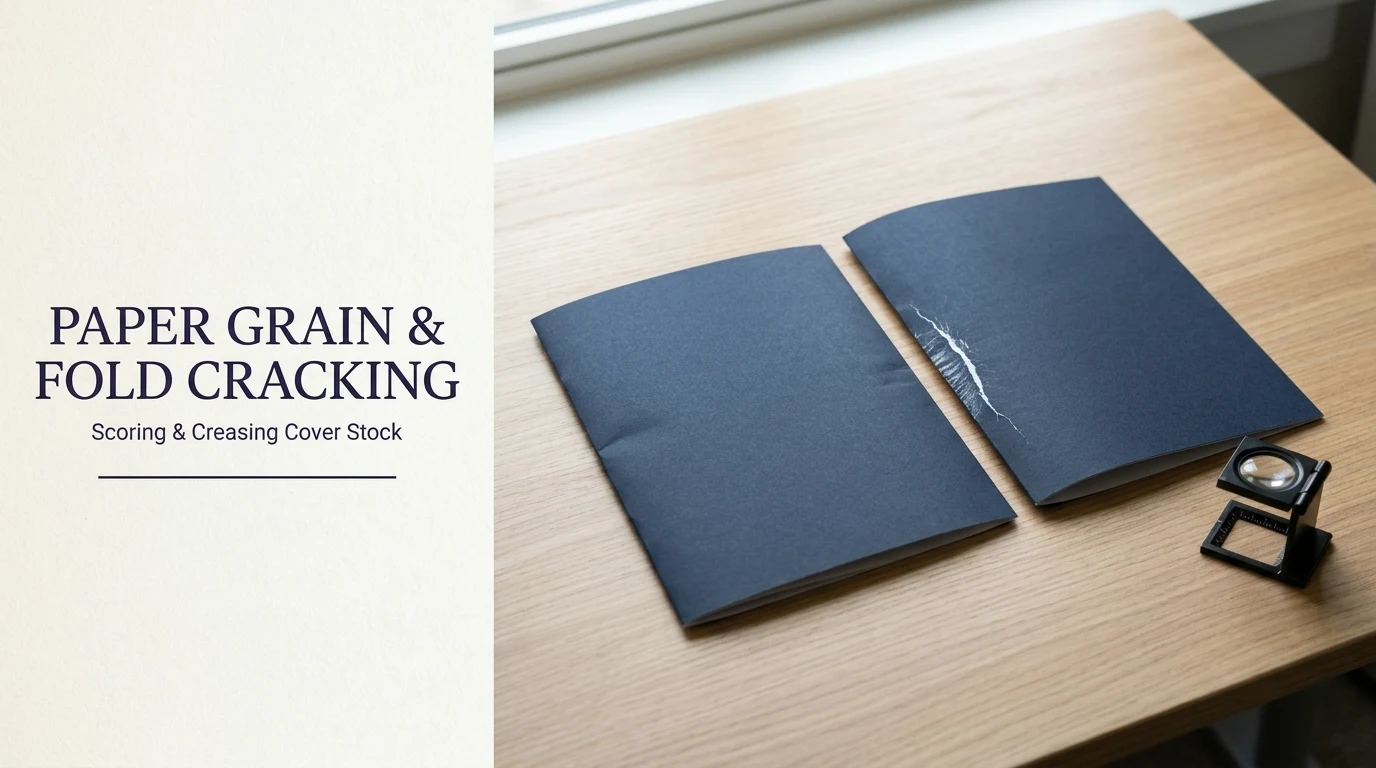
Folding and scoring parallel to the grain will break fewer fibers and result in a much cleaner, smoother fold, which can be demonstrated by taking a light cover stock, perhaps a 65 lb. cover, and folding it the length of the sheet and then folding it the width of the sheet.
When planning brochure layouts and bindery finishing, use the grain verification methods, environmental conditioning targets, rotary creasing specifications, and flatbed matrix channel formulas below. To review panel step-down geometry and basis weight selection before setting up the press sheet, consult the companion guide to brochure fold types and paper weight selection.
Grain-Long vs. Grain-Short Sheet Notation and Cross-Grain Behavior
Review the parent-sheet dimension order and grain alignment before imposing a folded brochure or bound cover on the press sheet.
On paper packaging, swatch books, and mill stock sheets, grain direction is most commonly noted as the last dimension of the sheet: as an example, 11×17-inch would be grain long (fibers run in the 17-inch direction) and 17×11-inch would be grain short (fibers run in the 11-inch direction).
When ordering paper by sheet size, the format normally tells you the grain direction: for example, 720mm x 1020mm paper would be 1020mm long, and 1020mm x 720mm paper would be 720mm short.
Paper fibers expand and contract as much as 400 percent more across the grain direction of the paper fiber than with the grain direction due to ambient conditions, glues, and binding moisture, which can cause problems including gusseting of the spine when bound across the grain.
An A4 magazine printed with the wrong grain direction is not OK because the wrong grain direction will force the book or the magazine to close rather than stay open naturally.
After confirming the sheet grain orientation on the press layout, verify front-to-back panel registration using the duplex tri-fold brochure back-to-back print check.
Shop-Floor Paper Grain Verification Tests and Laboratory Folding Standards
Use these bench verification procedures and standardized laboratory test methods to confirm paper grain direction and evaluate folding endurance.
Bench Tests for Unmarked Cut Stock
Compare an unprinted sample strip across both axes before committing the press run to the folder.
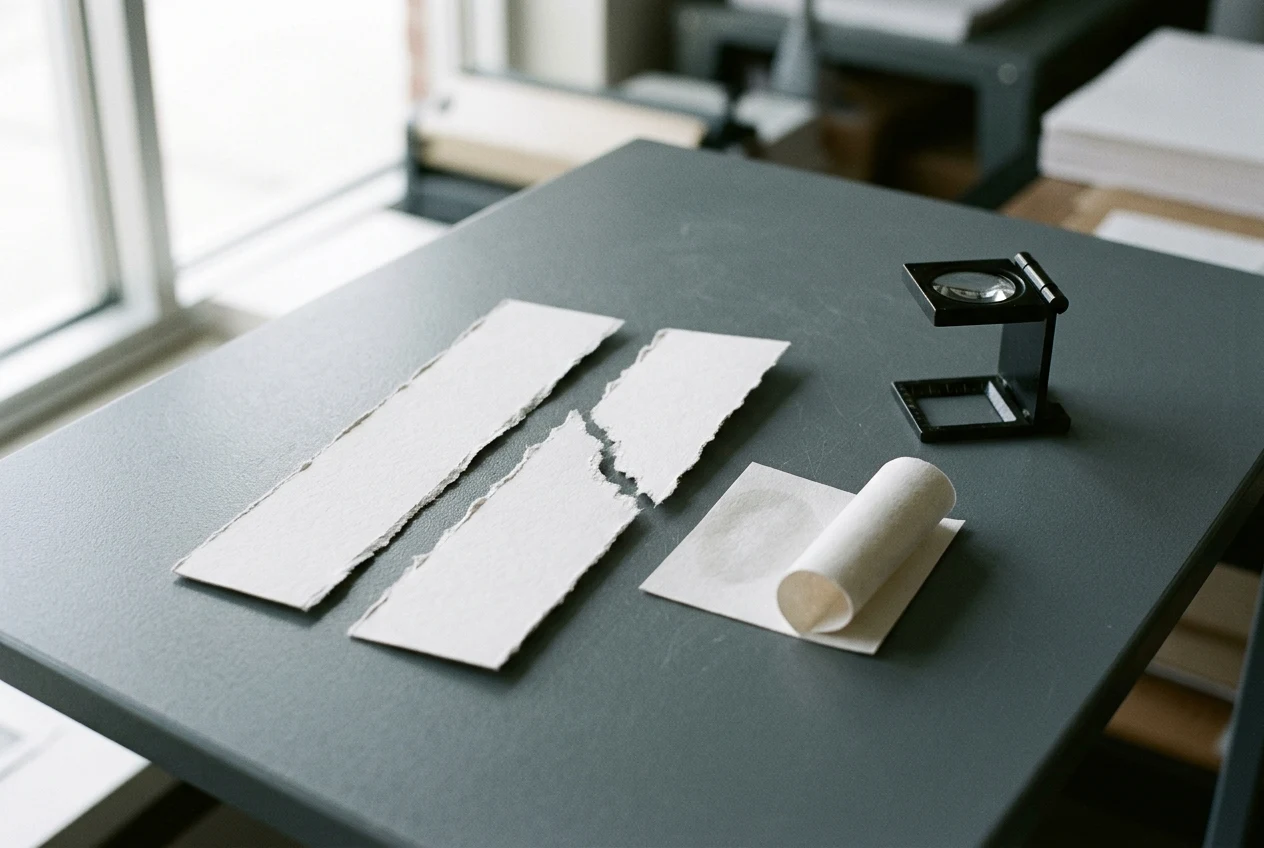
- In Kater-Crafts Bookbinders’ Moisture Test, if moisture is applied to one side of a sheet of paper, it immediately starts to curl in one direction, with the expansion on the cross-grain edge and the curl indicating the paper grain direction.
- In Kater-Crafts Bookbinders’ Bending and Tearing Tests, bending thicker papers in both directions shows that parallel to the grain direction the resistance is far less than against the grain, and when a sheet is torn in longitudinal and transverse directions, the tear pattern will be straight when parallel to the grain and jagged across the grain.
- In SEF, Inc.’s Tear Test and Thumbnail Test, tearing a sheet lengthwise for 4 or 5 inches produces a straighter tear along the grain, and when sliding a thumbnail under pressure along two adjacent edges, the long grain side of the paper should either be unchanged or have wide wavelike curves while the short grain side will have waves that are closer together.
Laboratory Folding Endurance Standards (ISO 5626 and TAPPI T 511)
Check the instrument scope, thickness boundaries, and folding-head thermal rules below when reviewing laboratory folding endurance reports.
| Standard parameter | Documented specification |
|---|---|
| Instrument methods | ISO 5626:1993(E) specifies the methods for the determination of folding endurance of paper using Köhler Molin, Lhomargy, MIT, and Schopper testers. |
| Double-fold cycle | ISO 5626:1993 Clause 3.1 defines a double fold as one complete oscillation of the test piece, during which it is folded first backwards and then forwards about the same line. |
| Reporting units | ISO 5626:1993 allows the results to be reported as either folding endurance, defined as the logarithm (to the base 10) of the number of double folds, or the fold number, defined as the antilogarithm of the folding endurance. |
| MIT strip and tension | TAPPI/ANSI T 511 om-20 defines folding endurance as the logarithm (to the base 10) of the number of double folds required to break the paper when a strip of paper 15 mm (0.59 in.) wide is tested under a standard tension of 9.81 N (1 kgf). |
| MIT head geometry | In the MIT folding head (Clause 4.1.2 and Clause 4.2), each of the two cylindrical folding surfaces shall have a radius of curvature of 0.38 mm (0.015 ± 0.001 in.) and a width of 19 mm (0.75 ± 0.04 in.), with a power-driven device imparting a rotary oscillating motion of 175 ± 25 cycles/min to fold the paper through an angle of 135° ± 2°. |
| Caliper rupture limit | Under TAPPI/ANSI T 511 om-20, the MIT tester is suitable for papers of any thickness; however, if the outer fibrous layers of paper thicker than about 0.25 mm (0.01 in.) rupture during the first few folds, the test loses its significance. |
| Thermal-humidity control | Clause 4.5 of the MIT folding endurance method requires a means for controlling the temperature of the folding head so that during folding it does not increase more than 0.5°C, because temperature rises of this magnitude will reduce the relative humidity at the fold by more than 2% and the number of folds by as much as 10%. |
Pressroom and Bindery Relative Humidity Conditioning
Review these standard conditioning atmospheres, preconditioning steps, and pressroom humidity targets before folding heavy stocks.
ISO 187:2022(E) specifies that the standard atmosphere for testing pulp, paper, and board shall be (23 ± 1) °C and (50 ± 2) % RH, while in tropical countries an atmosphere of (27 ± 1) °C and (65 ± 2) % RH can be used.
Under ISO 187:2022(E) Clause 6.1 (Preconditioning of the sample), for tests in which the hysteresis of the equilibrium moisture content can lead to important errors, the sample shall be pre-conditioned for 24 h in air of relative humidity between 10 % and 35 % and a temperature not above 40 °C before conditioning.
Under ISO 187:2022, with good air circulation a conditioning period of 4 h is usually sufficient for paper, a minimum time of 5 h to 8 h will be required for higher grammage papers, and boards of higher grammage and specially treated materials can require a conditioning period of 48 h or longer.
Technifold USA notes that a pressroom or bindery at 50% relative humidity will be less likely to have cracking problems than an environment at 25% relative humidity, and that on cover stocks at around 7pt (.007“) creasing (or scoring) paper is still needed.
Scoring vs. Creasing Mechanics, Substrate Thresholds, and Inline Rotary Tooling
Match the pre-folding method and bead orientation to the substrate basis weight, caliper, ink or toner system, and surface finish.
Grammage, Caliper, and Coating Thresholds
Review these documented weight and caliper thresholds when deciding between uncreased folding, rotary scoring, and channel creasing.
| Source benchmark | Documented threshold and process rule |
|---|---|
| KPP-Antalis | KPP-Antalis specifies that operators should fold a board over 170g (140g for Translucents) with prior creasing—otherwise it will crack when folding—and that especially for Translucent papers, the relative air humidity in the finishing and storage rooms should be about 50%. |
| Feldmuehle Exceo | While the processing step of creasing is usually necessary with grammages starting at 170 g/m² to minimize the cracking of paper and inks on the folding lines, Feldmuehle Uetersen GmbH optimized its Exceo coated fine paper in the basis weights range of 170 to 250 g/m² so that paper with a grammage up to 250 g/m² can now be folded without prior creasing. |
| Foldfactory | Foldfactory advises that if you are using a sheet that is 100 lb. text / 148 GSM or above, you should be scoring (noting that Trish Witkowski starts thinking about it at 80 lb. text), and explains that inline Heat Scoring can apply up to 350 degrees of heat to a copper die. |
| Mid-State Litho | Mid-State Litho states that as a rule, coated stock over 80 lb cover (216 gsm) should be creased, uncoated stock can often be scored up to about 100 lb cover, and digitally printed sheets should be creased regardless of weight because the toner layer is more brittle than offset ink; standard crease width is around 1.2 mm and thicker stock may want about 2 mm. |
| Castle Press | Castle Press states that scoring should be planned for all stocks that are .006 or thicker, notes that on Kromekote (a cast coated sheet coated on both sides) there may be flaking off on the inside of the fold, and states that press varnish, aqueous coating, or UV coating will not stop the edge of the fold from cracking whereas a film laminate encapsulates the surface of the paper. |
For a detailed comparison of how surface coatings and thermal films behave over folded spines, see the companion guide on spot UV, aqueous coating, and film laminate for brochures.
Bead Folding Direction and Rotary Elastomer vs. Steel Scoring
Compare the fiber delamination mechanics and tooling configurations below when setting up inline folding machines or standalone creasers.
Holmen Iggesund states that optimal creasing is obtained when multi-ply paperboard is delaminated into as many thin, undamaged layers as possible so that deep and narrow creases act as hinges, and notes that it is always easier to produce a perfect crease parallel to the fibre direction of the paperboard than parallel to the cross-fibre direction.
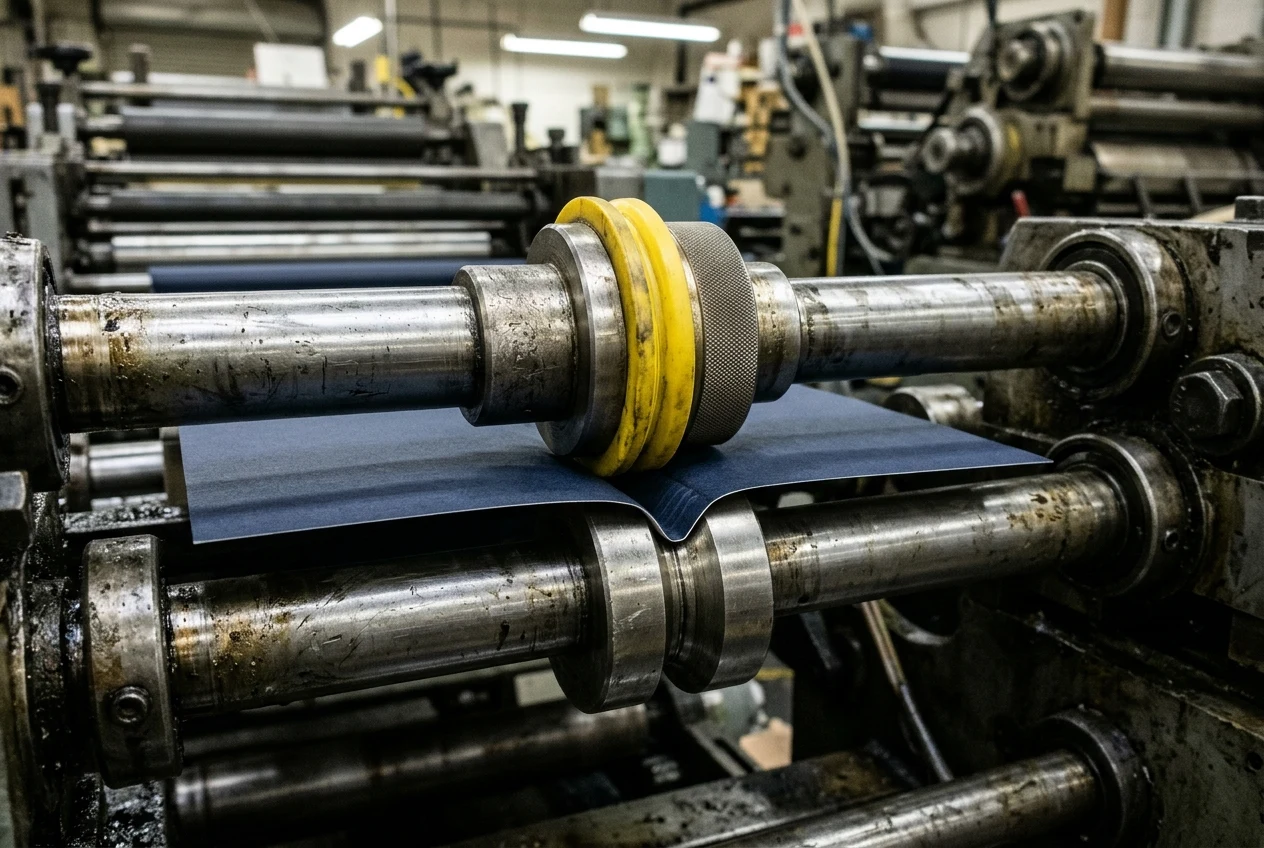
Holmen Iggesund specifies that to achieve the best function in flat-bed creasing, folding should always be done towards the bead (with the print side up), whereas inline rotary scoring for books and brochures is mainly done in the opposite way and adjusted to negative penetration (according to the DIN standard) so the bead does not obstruct the folding knife.
KPP-Antalis specifies folding into the bead because folding around the bead is likely to produce cracking—with the exception of Translucents papers, which go white when they are creased and should be folded away from the bead while ensuring a minimum distance of 4-6 mm between parallel folds (essential on 200gsm and above for Translucents).
Tech-ni-Fold states that OEM folding-machine scoring tools have barely changed since folding machines first appeared in 1850 and will never stop folded work from cracking for four reasons: (1) the steel blade is too destructive and crushes, splits, or cuts fibres; (2) it produces a V-shaped impression that concentrates stress at the point of the V; (3) it produces only one score setting, and a narrow score for paper falls short on 350gsm cover; and (4) it scores the inside of the fold rather than the outside.
Compiled alongside research by Sappi Fine Paper Europe (Brussels), Tech-ni-Fold’s Tri-Creaser uses a softer, patented rubber creasing rib that penetrates the stock up to three times deeper without splitting or damaging it, forming a rounded U-shaped crease on the outside of the fold across 85–350gsm stock at folding-machine speeds up to 30,000 sheets/hour on a Stahl folder (while the Tri-Creaser Easy Fit value version operates on 100–350gsm stock).
The Tech-ni-Fold Tri-Creaser has up to 8 pre-set crease options built in and uses three colour-coded creasing ribs matched to female channel settings: Orange for 85–200gsm, Blue for 170–270gsm, and Yellow for 250–350gsm.
To solve cracking and toner flaking on the inside of the folded piece, Technifold USA’s Nylon Female Creasing Rib replaces the normal 8 Channel Steel Female Component and introduces two creases from an upward direction on either side of the main top crease, with Fast Fit and EZ Fit models fitting 25mm Stahl and GUK, 30mm MBO and Horizon, and 35mm Stahl and MBO folding machines.
For web and in-line digital print finishing on heavy or coated stocks where scoring alone does not deliver the quality they need, EMT International’s Cross and Linear Creasing module (fully compatible with EMT’s Chameleon line and third-party systems) provides dual-direction creasing, adjustable crease depth, and barcode and job recipe integration.
Mid-State Litho categorizes commercial creasing equipment by daily volume—manual or semi-automatic units for up to ~1,000/day (manual desktop models start around $1,500), mid-volume semi-automatic units for 1,000–5,000/day (typically in the $5,000–$15,000 range), and fully automatic high-speed inline units such as the Horizon CRF-362 for 5,000+/day (running $25,000+).
Flatbed Creasing Matrix Channel Formulas, Rule Heights, and Crack Diagnostics
Apply these matrix channel calculations, grain-direction adjustments, and diagnostic checks when die-cutting and creasing heavy brochure covers or presentation folders on a platen or cylinder press.
Matrix Channel Width Formulas (1.5x vs. 1.75x) and In-Grain Reduction
Select the matrix channel width and shoulder depth according to board caliper, creasing rule thickness, and grain orientation.
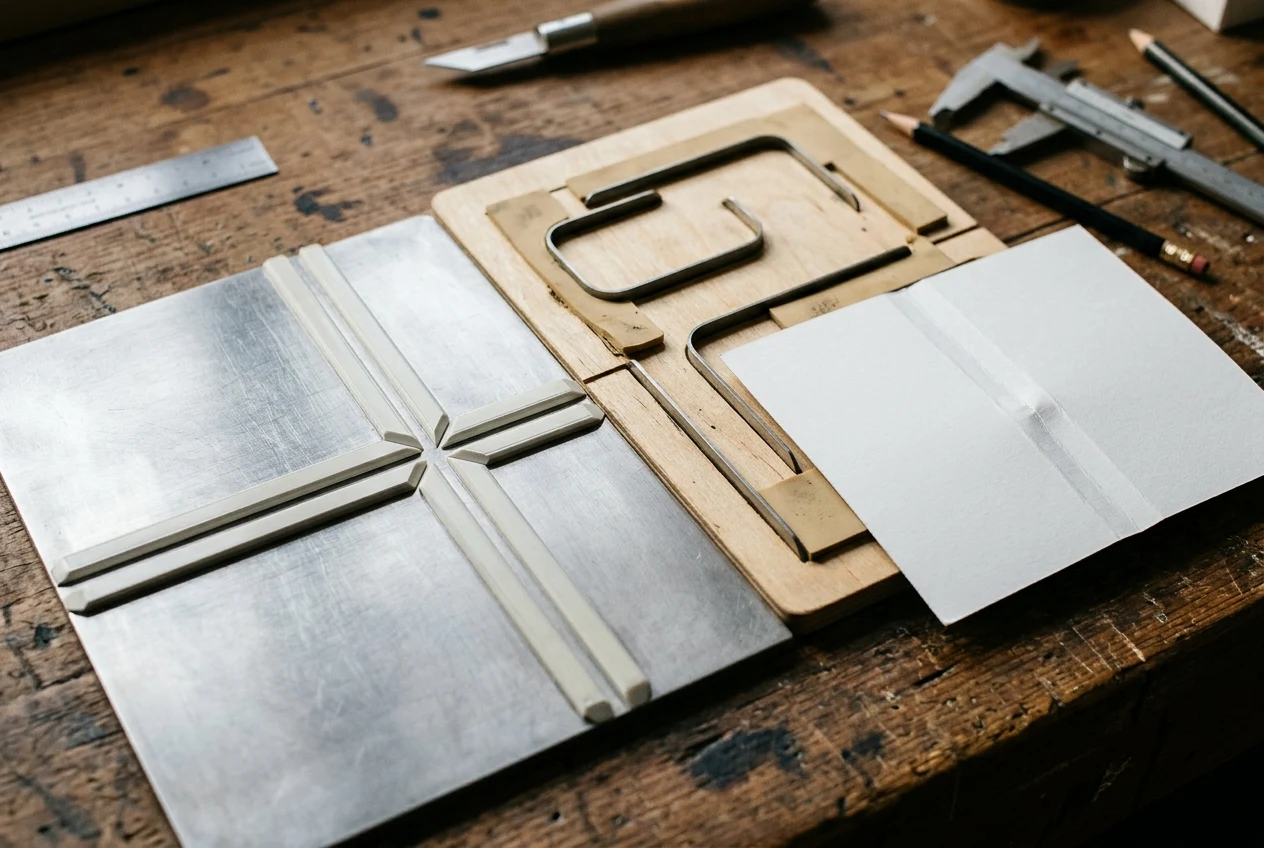
In the CITO Abacus creasing matrix calculation for solid cardboard (where press height f = 0.937 inch), channel depth is A = c, creasing channel width is B = (c × 1.5) + d, creasing rule height is g = f – c, and to optimize creasing quality you choose the next smaller channel width possible when creasing with the grain.
For a material thickness of 0.022 inch with a creasing rule of 0.028 inch / 2 pt, the CITO Abacus calculation recommends a channel depth (A) of 0.024 inch, a creasing channel width (B) of 0.059 inch, and a creasing rule height (g) of 0.913 inch, corresponding to CITO matrix size 0.6 × 1.5 mm.
KPP-Antalis specifies that for boards under 600 microns using a 2pt creasing rule, the matrix channel width is 1.5 times the thickness of the board plus the 2pt rule, and the matrix height is the thickness of the board.
BJ Industries specifies that creasing matrix ends should be chamfered at a 45-degree angle where creases meet, recommends that for carton board under 0.510mm you need to use a 2pt crease and for 0.510mm to 1.0mm use a 3pt crease rule, and lists rule thickness conversions of 1.5pt = 0.535mm, 2pt = 0.71mm, 3pt = 1.07mm, 4pt = 1.42mm, and 6pt = 2.14mm.
BJ Industries illustrates that for a cutting rule 23.8mm high and a board thickness 0.40mm thick, the crease rule height is 23.4mm high (with a matrix shoulder depth of 0.40mm), and states that for folding carton work against the grain, channel width (B) is calculated by multiplying the board thickness (C) by 1.75 and adding the crease rule thickness (D), while using the next smaller channel width for creases with the grain.
In PostPress, Joe McDowell (CCM Die Supply) explains that while the older channel width formula was 2 x the paper thickness + the crease rule width, the modern formula is 1.75 x material thickness + crease rule width, and notes that total channel width should be between three to four times the thickness of the material (up to 4 ½ is acceptable).
PostPress explains that across grain will give a more stable crease than with grain because the material will delaminate in long lines when creasing across grain, whereas when creasing with the grain, fibers have a tendency to cluster into pockets that may cause cracking unless operators narrow the channel to the matrix that is the next size down.
Crease Rule Height, Matrix Membrane Deduction, and Crack Location Diagnostics
Account for the matrix channel membrane thickness and inspect the exact position of any surface fracture on press delivery.
In flat diecutting, PostPress notes that some counter materials are made for short runs of 15,000 or less, while others can run hundreds of thousands of impressions, and calculates crease rule height as (cutting rule – material being diecut) – (membrane thickness), where a metal matrix membrane is approximately .010″ thick, a Mylar or plastic membrane usually is .005″ thick, and many diemakers have settled at .006″ alongside cutting/crease rule tolerances of +/- .001″ and cutting plate tolerances of +/- .002″.
PostPress diagnoses common diecutting crease crack locations across three modes: cracking on the sides of the crease (usually noticed on delivery before folding) usually is caused because the channel is too narrow; cracking on the bottom of the crease (usually noticed on delivery before folding) is the result of the crease rule being too high; and cracking on the folder-gluer, where the crease looks nice on delivery but cracks when folded, generally is caused by a crease rule that is too low.
Once the dieline, fold marks, and matrix specifications are finalized, bundle the native layout and production notes using the InDesign file packaging and print handoff checklist.
Paper Grain Direction and Creasing Matrix Verification Checklist
Include this verification record on the bindery job ticket to align prepress imposition, stock purchasing, and finishing setup before starting production.
- Parent-sheet and cut-sheet grain notation: record the sheet dimensions and confirm that the primary spine fold runs parallel to the grain direction.
- Bench grain verification: verify unmarked stock using a longitudinal tear, bending resistance comparison, or single-sided moisture-curl test.
- Pressroom and bindery humidity: log the relative humidity in the storage and finishing areas and allow adequate conditioning time before folding.
- Pre-folding method and bead orientation: record whether the job uses rotary elastomer creasing or flatbed matrix creasing, and verify whether the stock folds into the bead or away from the bead.
- Matrix channel width and rule height: record the board caliper, creasing rule thickness, cross-grain channel width, next-size-down in-grain channel width, and membrane-adjusted rule height.
- Delivery crack inspection: inspect initial press sheets on the sides and bottom of the crease before folding and after folding to confirm internal ply delamination.
Browse additional print design and bindery production guides to coordinate prepress file setup, ink coverage limits, and postpress finishing.
Sources
- TAPPI — TAPPI/ANSI Test Method T 409 sp-23 Machine Direction of Paper and Paperboard
- TAPPI — TAPPI/ANSI T 511 om-20 Folding Endurance of Paper (MIT Tester)
- ISO — ISO 5626:1993(E) Paper — Determination of Folding Endurance
- ISO — ISO 187:2022(E) Paper, Board and Pulps — Standard Atmosphere for Conditioning and Testing
- CITO-SYSTEM GmbH — CITO Abacus Creasing Matrix Calculation Aid
- Holmen Iggesund — Graphics Handbook: Creasing and Folding in Practice
- KPP-Antalis — Print Techniques: Creasing and Folding
- BJ Industries Ltd — Creasing Matrix Technical Selection Guide
- PostPress Magazine — Grain Direction: The Long and Short of It
- PostPress Magazine — Understanding the How and Why for Quality Creasing Outcomes
- Tech-ni-Fold Ltd — Tri-Creaser Technical Overview
- Technifold USA — Nylon Female Creasing Rib for Inside Cracking and Toner Flaking
- Technifold USA — Why is Creasing (or Scoring) Paper Important?
- Foldfactory — When Should You Score a Folded Brochure?
- Packaging Europe — Folding Without Creasing with Feldmuehle
- INKISH.NEWS — Come on, guys - grain direction issues in 2022?
- INKISH.NEWS — EMT International Launches Advanced Creasing Solution
- Mid-State Litho — Paper Creasing vs Scoring
- SEF, Inc. — Understanding Paper Grain
- Castle Press — What Causes Paper to Crack When It Is Folded?